
Coming in 2026-2027: A New Generation of ACRE
The ACRE (Assessment of Catholic Religious Education) provides schools and parishes with a tool to evaluate how well students are learning and living the Catholic faith. More than an assessment, ACRE helps you walk with your students and understand both their knowledge and their lived experiences.
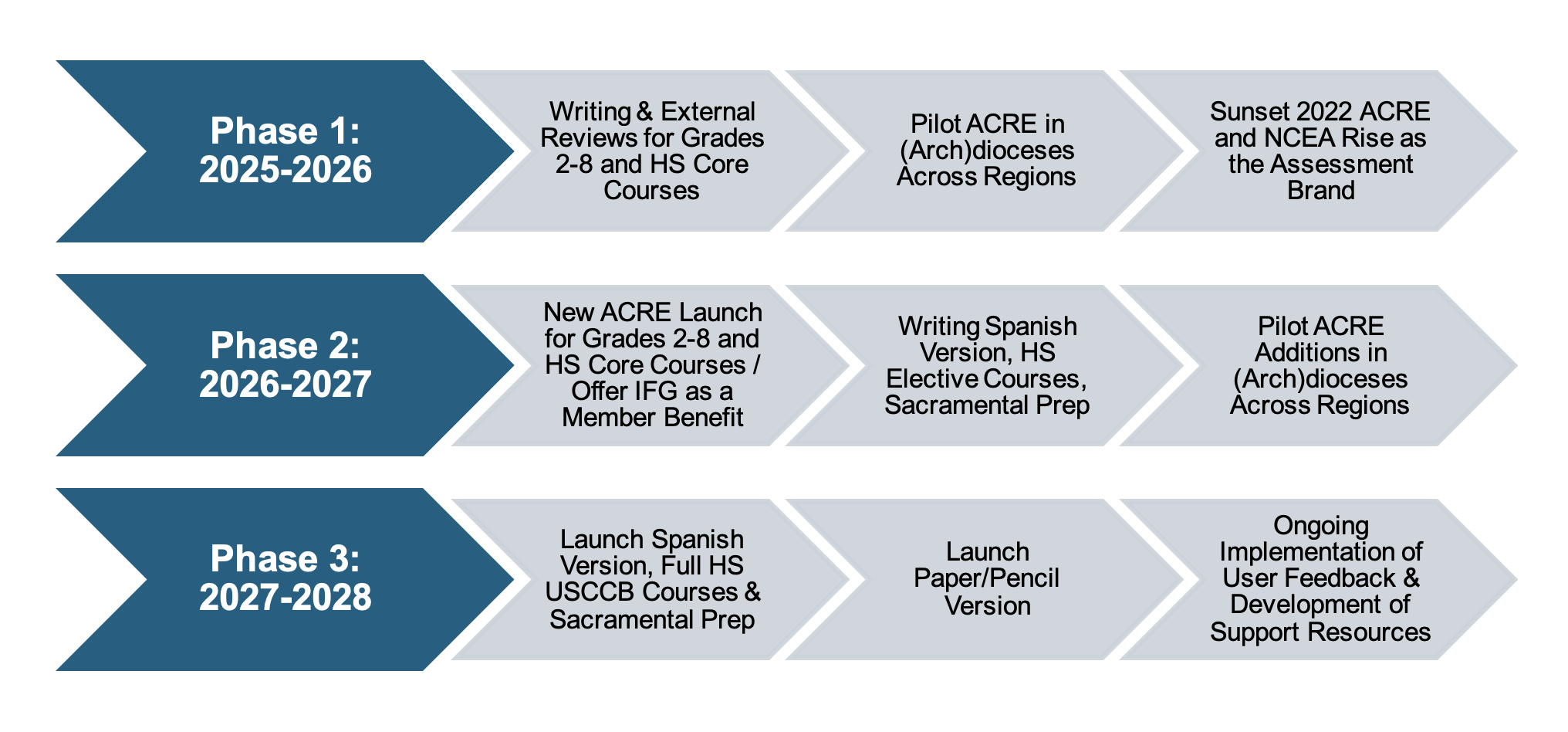
The 2022 ACRE version and the NCEA Rise brand will sunset after the 2025-2026 school year. A new ACRE version will be launched in 2026-2027.
See Press Release Fill Out the Interest Form
ACRE is important because it:
- Measures knowledge (head)
- Assesses beliefs and attitudes (heart)
- Guides curriculum and instruction
- Encourages student reflection
- Supports a culture of faith
- Fosters growth over time
- Informs accreditation protocols, decision-making, and strategic planning
- Promotes accountability in mission
Content for the revised ACRE is being aligned with two essential U.S. Conference of Catholic Bishops (USCCB) documents:
- Handbook on the Catechetical Accompaniment Process (Elementary and Middle School)
- Doctrinal Elements of a Curriculum Framework for the Development of Catechetical Materials for Young People of High School Age (High School)
What to Expect
- Assessments available for all grades 2–12
- Individualized student reporting that empowers growth
- More robust and reliable reporting tailored to different users—from classroom teachers to bishops
- Access to Spanish versions for the diverse communities we serve
- Options for both online and paper/pencil versions will be available
- Pre- and post-test students for formative and summative assessment at no extra cost
Each elementary and middle school assessment (grades 2-8) and the six Core Courses of the High School Curriculum Framework will measure both cognitive (i.e., what students know about the faith) and affective (i.e., what students actually believe and practice with regard to faith) dimensions. Question items will correspond to key concepts contained in these documents. In reports to schools and dioceses, multiple-choice answer options and rationales will provide citation references to the Catechism of the Catholic Church, which will assist teachers and catechists in guiding curriculum and instruction.
Informational Webinar
New ACRE Assessment: Driving Religion Instruction with Actionable Data
Catholic education is about more than knowledge—it’s about forming disciples. The new ACRE Assessment empowers educators with actionable insights that go beyond test scores, helping you strengthen both intellectual understanding and spiritual growth. In this webinar, you’ll discover:
- How ACRE’s enhanced reporting connects data to mission.
- Practical strategies to enrich religious instruction and foster authentic faith formation.
- Ways to use results to guide curriculum and pastoral planning for deeper engagement.
Join us to learn how data can become a powerful tool for evangelization and catechesis—helping students not only know their faith but live it.
Register to Watch On-Demand
Frequently Asked Questions
General ACRE Questions
- What is ACRE? The Assessment of Catholic Religious Education (ACRE) provides schools and parishes with a tool to evaluate how well students are learning and living the Catholic faith. More than an assessment, ACRE helps you walk with your students and understand both their knowledge and their lived experiences. ACRE is administered in two parts:
- Part 1 – Religious Knowledge (Cognitive Goals): This asks questions about the teachings of the Church revealing students’ “head” knowledge of Catholicism.
- Part 2 – Personal Beliefs, Attitudes, Practices, and Perceptions (Interior Life & Behavioral Goals): This asks questions about personal beliefs, attitudes, practices, and perceptions revealing students’ “heart and hands” knowledge of Catholicism.
- How does the 2026 revised ACRE compare to the 2022 ACRE version? New features of the 2026 revised ACRE include:
- Assessments available for all grades 2–12
- Individualized student reporting that empowers growth
- More robust and reliable reporting tailored to different users—from classroom teachers to bishops
- Access to Spanish versions for the diverse communities we serve will be available in 2027-2028
- Options for both online and paper/pencil versions will be available in 2027-2028
- Pre- and post-test students for formative and summative assessment at no extra cost
- Why should I adopt ACRE? ACRE is important because it:
- Measures knowledge (head)
- Assesses beliefs and attitudes (heart)
- Guides curriculum and instruction
- Encourages student reflection
- Supports a culture of faith
- Fosters growth over time
- Informs accreditation protocols, decision-making, and strategic planning
- Promotes accountability in mission
- What do I need to know about the rollout of the revised ACRE? ACRE is being developed in a three-year plan:
Participating in ACRE
- Does ACRE offer both online and
offline (paper/pencil) versions? ACRE is only available online in 26-27.
The paper/pencil version will be available in 27-28.
- If I
order the offline (paper/pencil version), how will this be processed?
Paper options will be available in 27-28 and can be utilized through the
DnA platform. Once ACRE is purchased for 27-28, both digital and paper
options will be available and paper forms can be printed on demand from
the DnA platform.
ACRE Test Design
- Is ACRE dependent on any particular curriculum? No. Content for the revised ACRE is aligned with two essential U.S. Conference of Catholic Bishops (USCCB) documents:
- Handbook on the Catechetical Accompaniment Process (Elementary and Middle School)
- Doctrinal Elements of a Curriculum Framework for the Development of
Catechetical Materials for Young People of High School Age (High School)
- Note: The new high school ACRE is not administered by grade-level per
se (i.e., 9, 10, 11 and 12), but rather, by the courses prescribed by
U.S. Catholic Bishops.
- Can I add any customized questions to ACRE? Questions cannot be added to ACRE. However, DnA does provide options
for flexible assessments with customized question items.
- How long does it take to complete ACRE for various grade levels? Because ACRE is offered to all grades 2-12, the time to administer
and complete the assessment depends on the student and the grade-level.
It is possible to split ACRE into separate assessment sessions for Part 1
and Part 2 as long as teachers and/or students do not close the
assessment altogether.
Administering ACRE
- What is the pricing for ACRE? ACRE is $2.50 per student. Dioceses also have an onboarding fee of
$3,500. Professional learning is highly recommended and pricing varies.
Contact your Renaissance Sales Representative for quote information. If
you’re not sure who to contact, complete the Interest Form and a
Renaissance Account Executive will reach out to you.
- How do I get started? Is there a recommended way to order ACRE (e.g., through the diocese or as a separate school entity)? It is highly recommended that schools purchase and roster ACRE
through their Diocesan Schools Office under a single diocesan account.
This will ensure that all schools in the diocese will be included in the
diocesan aggregate report. This is important for bishops and
superintendents. It will also allow schools to receive the best pricing
and streamline the onboarding process. Schools that purchase their
ACRE license independent of a diocesan account will not be included in
your diocesan aggregate reports.
- The first step will be for
diocesan offices to fill out the Interest Survey for all participating
schools in the diocese. Your assigned Renaissance Account Manager will
then contact you with detailed instructions on both purchasing and
onboarding.
- How do I order ACRE for multiple organizations if I want separate score reports? Reports can be accessed via the DnA platform at any time. Depending
on the users access level and the schools rostered on the account,
reports at the diocese, school, class, and student level are available.
If a school is not using the diocese’s instance of DnA and are on their
own instance, the diocese will not have access to school level reporting
in their DnA instance.
- How much lead time before giving ACRE should I plan for? Can a person order ACRE at the last minute? You should allow 3-5 weeks for onboarding and professional learning.
This is dependent on the communication and coordination with the main
Diocesan contact. School-based leaders will work with primary
contact from the Diocese to participate in the onboarding of the DnA
platform, which is the ACRE administration platform. After onboarding,
teachers will need to participate in professional learning sessions to
learn how to administer the assessment.
- Are proctoring instructions provided for ACRE? Yes, teacher and student quick guides will be available for 26-27. We
recommend all teachers have participated in the professional learning
session, “Administering ACRE on DnA” to learn the details of
administration. The quick guides are meant as supplements to training.
- Are there built-in provisions for students with special learning needs? Yes, there are several accommodations that can be given to students with special learning needs. They include:
- Magnification: This feature allows students to enlarge text and images on the screen for better visibility.
- Strikethrough: This tool allows students to cross out incorrect or irrelevant options in multiple choice questions.
- Text to Speech (TTS): This read-aloud tool vocalizes text from the online assessment for students.
- Color Contrast: This online testing tool enables students to modify
the color scheme of their online testing experience to assist in viewing
their assessment, particularly beneficial for students with color
blindness. Students can choose from 12 different color palettes in their
assessment.
Professional Learning
- What kind of resource support is provided for dioceses, schools and parishes? For the 26-27 school year, there will be a dedicated site for ACRE
users to go for resources and information. The DnA Knowledge Base also
has resources to support users as they set up and administer DnA.
Additional resources are shared during professional learning sessions.
- How do diocesan leaders implement ACRE across multiple schools and parishes? It is highly recommended that schools purchase and roster ACRE
through their Catholic Schools Office under a single diocesan account.
This will ensure that all schools in the diocese will be included in the
diocesan aggregate report. This is important for bishops and
superintendents, as it will give insight into strengths and areas for
growth in both the cognitive and affective dimensions of their students’
understanding and lived faith.
- Once schools have completed
administering ACRE, trainings and consultations on scoring and reporting
are available. The professional learning session, “ACRE Reporting on
DnA” is recommended. When scheduling professional learning, a Planning
and Scheduling Coordinator can help select the most appropriate
session(s).
ACRE Reporting
- Will I be able to get updates on how my ACRE results are going? ACRE results are immediately available after administration and can
be accessed via the DnA platform at any time. Depending on the user's
access level and the schools rostered on the account, reports at the
diocese, school, class, and student level are available. Administrators
can also monitor test administration and participation in the DnA
platform during testing.
- What types of reports will I receive? The DnA platform provides more than 30 user-friendly pre-built
reports for teachers, administrators, and parents. DnA also supports the
creation of ad hoc reports as needed. Descriptions and examples of some
key DnA reports are provided below.
- a. Pre-Built Reports.
DnA's straightforward interface facilitates the ability to run pre-built
reports. Pre-built reports are easy to use and allow you to drill to
the student level for pertinent data. In addition, reports can be
exported to PDF, CSV, XLSX, or directly to a printer. All reports can be
shared among users throughout the diocese and viewed based on roles and
permissions.
- b. Assessment Matrix Report. The Assessment
Matrix Report displays individual student and classwide performance on
an overall assessment and on specific items, standards, or question
groups.
- c. Response Frequency Report. The Response Frequency
Report identifies specific errors to inform re-teaching and
in-the-moment feedback. This report enables teachers to view item level
information to quickly pinpoint the most-missed questions.
- d.
Performance Summary Report. The Performance Summary Report allows users
to compare your students’ performance to that of other periods, the
site, and the diocese.
- e. Peer Comparison Report. The Peer
Comparison Report shows how students, teachers, or sites performed on
the test and in relation to one another.
- f. Teacher Peer
Comparison Report. With the Teacher Comprehensive Report, educators can
compare their classroom performance against site and diocese averages
across multiple metrics.
- Can I access my reports online if I administered the offline version? When the paper version is available in 27-28, student responses are
entered into the DnA platform and online reports are available.
- Who gets the results since ACRE is usually administered at the
direction of the superintendent’s office? Do they automatically get
aggregate results? Schools that purchase ACRE independent of
their Catholic Schools Office (CSO) will not be included in diocesan
aggregate reports. For this reason, it is highly recommended that
schools purchase and roster ACRE through their CSO under a single
diocesan account. This will ensure that all schools in the diocese will
be included in the diocesan aggregate report, which is important data
for bishops and superintendents.
Support and Privacy
- What is the policy on student privacy data?
For more information, please visit our Privacy Hub: Privacy Hub | Renaissance
- Who do I contact for technical support?
The Renaissance Support Team can be reached by emailing [email protected], using the Live Chat that can be accessed when you’re logged in to your Renaissance platform, via phone at (800) 338-4204, or by submitting a Support Form.
- Who do I contact with questions about content? For questions regarding ACRE content, contact John Galvan at NCEA at [email protected] or at 571-257-0017.